 Skip to content
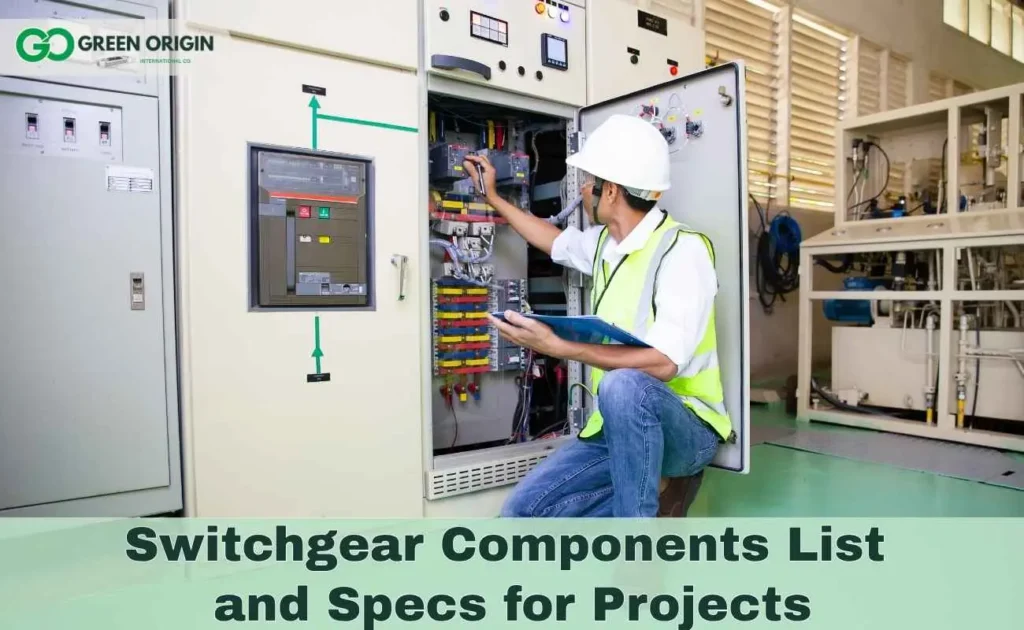
The Switchgear Components List defines every device inside a switchgear assembly – from circuit breakers and busbars to protection relays and enclosures, According to industry research, 80% of switchgear failures are caused by overheating – making correct component selection and maintenance a direct operational cost driver for utilities and industrial facilities across Africa.
What Is the Switchgear Components List?
The Switchgear Components List is the complete inventory of devices assembled inside a switchgear enclosure, Every item on this list has a defined role – together they control, protect, and isolate electrical circuits, The two main categories of switchgear parts are power-conducting components and control and monitoring components.
Power-conducting vs. control components:
Per IEEE standards (IEEE C37.20.3), switchgear assemblies divide into two functional groups:
- Power-conducting parts: Circuit breakers, fuses, disconnect switches, busbars, and lightning arresters – carry and interrupt electrical power.
- Control and monitoring parts: Protection relays, instrument transformers, control panels, metering devices, and auxiliary wiring – monitor, control, and protect the power-conducting components.
Read More: What Is Switchgear and Its Types for Industrial Projects?
List of Primary Power Conducting Parts in Switchgear:
The primary power-conducting electrical switchgear parts in any Switchgear Components List are the devices that carry and interrupt load and fault current:
- Circuit Breakers: Core interrupting device – automatically trips to isolate fault currents; available in SF6, vacuum, oil, and air types for LV, MV, and HV applications.
- Busbars: Rigid copper or aluminum conductors that collect incoming power and distribute it to outgoing feeders – the central power junction of the assembly.
- Disconnect Switches (Isolators): Provide a visible open-circuit break for safe maintenance – must only be operated under no-load conditions.
- Fuses: Overcurrent protection through a sacrificial element that melts under fault conditions – cost-effective for LV and some MV applications.
- Lightning Arresters (Surge Arresters): Divert lightning-induced overvoltage surges to earth – the first protective device on incoming lines.
Essential Protective and Circuit Interrupting Components:
Protection devices form the intelligence layer of the Switchgear Components List, These electrical switchgear components detect abnormal conditions and coordinate fault clearance:
- Protection Relays: Monitor electrical quantities (current, voltage, frequency) and send trip signals to circuit breakers within milliseconds – available in electromechanical, static, and numerical (digital) types.
- Current Transformers (CTs): Scale down high primary currents to measurable levels (1A or 5A secondary) for protection relays and metering instruments.
- Voltage Transformers (VTs/PTs): Step down high voltages to standard levels (typically 110V) for protection relays, metering, and synchronizing equipment.
- Earth Fault Relays: Detect current leakage to earth – critical for personnel safety and equipment protection in industrial and distribution substations.
Control and Monitoring Switchgear Components List:
The control and monitoring section of the Switchgear Components List enables operators to supervise and manage the entire assembly, These switch gear components include:
- Control Panels: The central command interface – contain indicating lamps, pushbuttons, selector switches, and displays for local operation and supervision of all circuits.
- Metering Devices: Ammeters, voltmeters, wattmeters, and energy meters measure electrical parameters for billing, performance monitoring, and fault analysis.
- SCADA and Remote Terminal Units (RTUs): Enable remote monitoring and control from a centralized control center – increasingly standard for unattended distribution substations across African networks.
- Auxiliary Power Supply: DC battery backup system that powers protection relays, trip coils, and control circuits during mains power failure – typically 110V or 220V DC per IEC 61936-1.
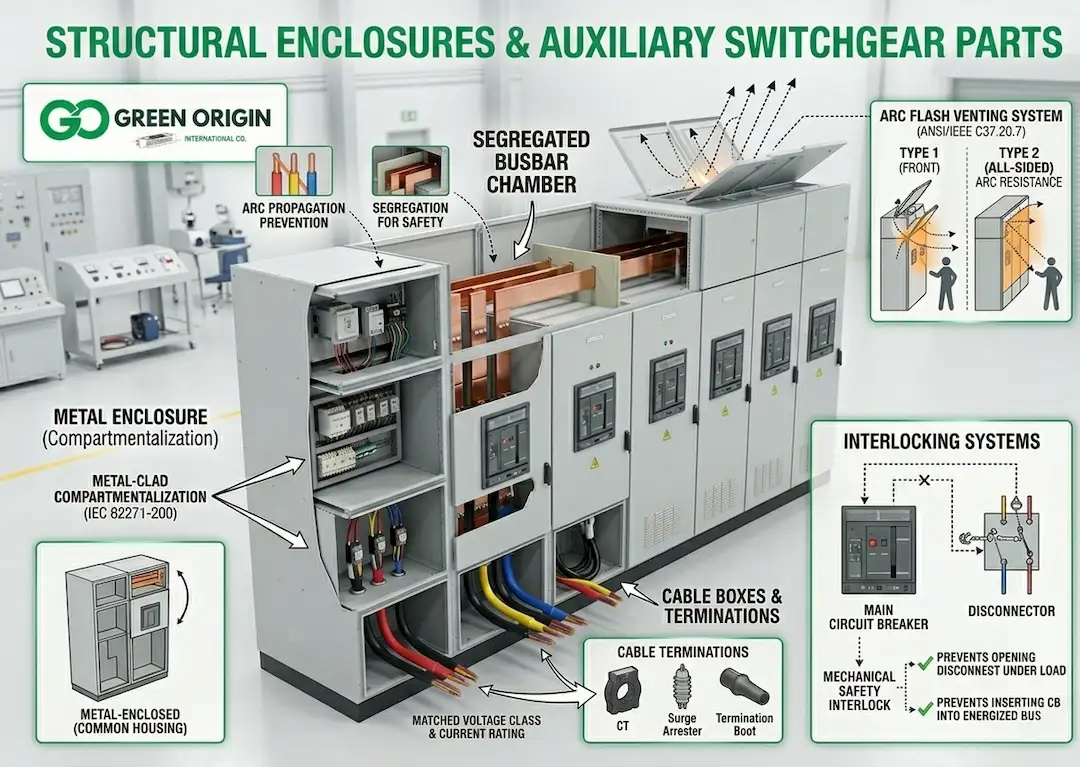
Structural Enclosures and Auxiliary Switchgear Parts:
Structural and auxiliary switchgear parts house and support all active components, A complete Switchgear Components List includes these enclosure and auxiliary elements:
- Metal Enclosure: Metal-clad types provide separate compartments per IEC 62271-200; metal-enclosed types share common housing.
- Busbar Chambers: Segregated compartments protecting busbars from accidental contact and arc propagation between phases.
- Cable Boxes and Terminations: Connect incoming and outgoing cables – matched to cable type, voltage class, and current rating.
- Arc Flash Venting Systems: Arc-resistant enclosures redirect flash energy away from operators per ANSI/IEEE C37.20.7 – Type 1 (front) and Type 2 (all-sided).
- Interlocking Systems: Prevent unsafe operations – such as opening a disconnect under load or inserting a breaker into an energized busbar.
Read More: difference between switchgear and distribution board.
Component Failure Statistics and Equipment Reliability Trends:
Understanding failure patterns across the Switchgear Components List enables engineers to prioritize maintenance, Per IEEE Xplore research on electrical switchgear components condition assessment, the main failure categories are:
- Mechanical failures: ~25% of major circuit breaker failures – worn springs, seized mechanisms, and lubrication degradation.
- Insulation breakdown: Leading failure mode in MV and HV switchgear – driven by partial discharge, moisture ingress, and aging materials.
- Overheating and thermal stress: Primary cause per EPRI data – exacerbated in Africa by high ambient temperatures and solar radiation.
- Control circuit failures: ~25% of HV circuit breaker failures trace back to auxiliary control circuits per IEEE research.
- Corrosion and environmental damage: Major issue for outdoor switchgear in coastal and high-humidity African environments.
What to Check When Selecting Switchgear Components and Parts?
Correct selection of every item on the Switchgear Components List requires evaluating these parameters for each electrical switchgear parts category:
- Voltage rating: Every component must be rated at or above system maximum voltage – LV (up to 1 kV), MV (1–36 kV), or HV (above 36 kV).
- Short-circuit withstand rating (kA): Must withstand and interrupt available fault current without damage.
- Continuous current rating: Must exceed maximum expected load current including future growth.
- Standards compliance: IEC 62271 for international projects; IEEE C37 for North America – African projects typically require IEC.
- Environmental rating: IP rating, temperature derating, and pollution severity per IEC 60815 – critical for coastal and desert African deployments.
- Interchangeability and availability: Spare parts lead times – particularly important for remote African substation locations.
Why Green Origin Is Your Trusted Supplier for Switchgear Components?
Green Origin supplies the complete Switchgear Components List for African and Middle Eastern power projects – covering every switch gear components category from circuit breakers and busbars to enclosures and auxiliary systems, Every product meets IEC 62271 and IEEE C37 standards:
- IEC 62271 certified LV, MV, and HV components: Full compliance documentation for African utility tender submissions.
- Africa-optimized engineering: IP-rated enclosures and corrosion-resistant hardware for coastal and desert environments.
- Full OEM / ODM capability: Custom ratings, configurations, and voltage classes per project specifications.
- Reliable supply chain: Predictable lead times across Sub-Saharan Africa and the Middle East.
- Technical support: Load flow analysis, protection coordination, and specification assistance.
Read More: Top Switchgear Companies in World.
Premium Switchgear Parts and Custom Assembly by Green Origin:
Green Origin provides a full Switchgear Components List across all voltage classes for overhead and underground distribution networks:
- MV Metal-Clad Switchgear (11–36 kV): IEC 62271-200 compliant; vacuum circuit breakers with motorized racking for safe remote operation.
- Ring Main Units (RMUs): Compact SF6 or vacuum insulated switchgear for underground cable networks – ideal for urban African distribution.
- LV Switchgear Panels: MCCBs, ACBs, and motor control centers for industrial and commercial secondary distribution.
- Outdoor Pad-Mounted Switchgear: IEEE C37.74 compliant; 5–38 kV for underground distribution systems.
- Custom Assembly Service: Fully assembled, tested, and factory-accepted switchgear panels delivered project-ready.
For inquiries or OEM requests, trust Green Origin for premium switchgear solutions tailored to your industrial projects. Simply contact us or use WhatsApp to discuss your specifications, or visit the full product range on our website to ensure a reliable power distribution system.
FAQs:
Can I mix switchgear parts from different brands?
Mixing brands is possible if all components meet the same IEC or IEEE standards and ratings – however, interoperability must be verified through coordination studies and the switchgear manufacturer’s compatibility documentation.
What is the most common cause of switchgear component failure?
Insulation breakdown and overheating are the leading causes – driven by aging, moisture ingress, overloading, and in African deployments, high ambient temperatures and corrosion.
Are switchgear components interchangeable between LV and MV systems?
No – LV and MV components are rated for different voltage and current levels. Substituting components across voltage classes creates serious safety and compliance risks per IEC 62271 standards.
Sources:
- IEEE Xplore – Switchgear Condition Assessment and Lifecycle Management.
