 Skip to content
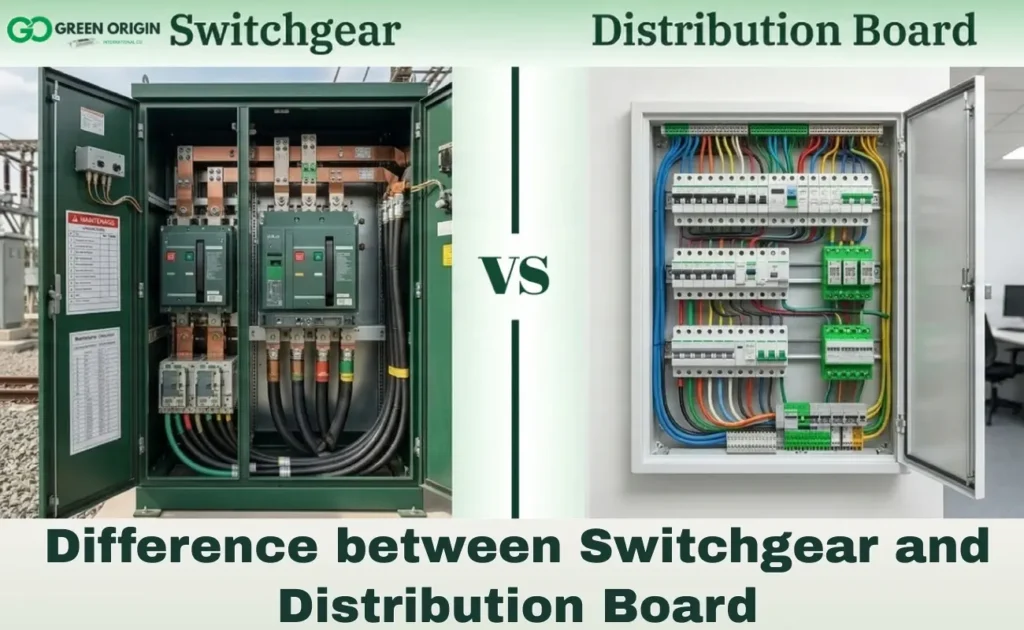
Distribution boards and switchgear are crucial parts of an electrical power system. However, you can find difference between switchgear and distribution board. Switchgear handles control, protection, and isolation of electrical equipment of medium and high voltage in power networks. Conversely, distribution boards are utilized in low voltage systems for the safe distribution of power to different branches of a circuit within a building, plant, or residential wiring.
What is Switchgear and What Are Its Components?
An electrical system that includes switchgear is designed for the control, protection, and isolation of equipment in power networks. It ensures safe distribution of power and rapid isolation of faulty sections to protect against damage and maintain system stability.
- Protective circuit breakers shut off flow of the fault current in the event of short circuit or overload.
- Disconnector switches allow isolation of equipment for maintenance or repairs.
- Protective relays sense some conditions of the current and voltage which are not normal and energize the circuit breaker.
- The control panel supervises the operation of opening and closing switches in the power system.
Core Technical difference between switchgear and distribution board:
The core specialized difference between switchgear and distribution board lies in their voltage range, function, and operation within the electrical system. Switchgear is designed to control, cover, and insulate medium and high- voltage electrical outfit in power transmission and distribution networks.
It includes advanced protection bias similar as circuit combers, relays, and dissociate switches to manage fault conditions and insure system stability. In discrepancy, a distribution board operates in low- voltage systems and primarily distributes electricity to multiple circuits within structures or installations. It generally contains atomic circuit combers( MCBs), fuses, and residual current bias( RCDs) to cover individual circuits and insure safe electrical distribution.
However, there are many other comparisons like difference between switchgear and distribution panel, difference between switchgear and switchboard, difference between switchgear and panel, main distribution panel vs switchboard, but finally all of them are related to the last core difference.
Read More: Ring Main Unit Meaning: Electrical Distribution Guide.
Where to Use Switchgear vs Distribution Boards?
Switchgear is primarily used in high- and medium- voltage operations to control, cover, and insulate electrical outfit. Common locales include power generation shops, substations, artificial installations, and large structure systems similar as airfields, railroads, and data centers. It’s also stationed in mileage grids for transmission and distribution networks, icing safe operation, fault insulation, and continued power inflow in critical sectors.
Distribution boards are used in low- voltage surroundings to safely distribute electricity to multiple circuits. Typical locales include domestic structures, marketable services, seminaries, hospitals, manufactories, shopping promenades, and lower artificial shops, furnishing protection via circuit combers and fuses for individual circuits.
Read More: Top Switchgear Companies in World.

Advantages of Modern Digital Control in Switchgear and Distribution Boards:
Although there is difference between switchgear and distribution board in many factors, but intelligent automation, monitoring, and operational efficiency of electrical power systems across industrial, commercial, and utility applications, are being advanced by modern digital control technologies integrated into switchgear and distribution boards.
The features include:
- Improved operational awareness through real-time monitoring of voltage, current, temperature, and equipment status.
- Avoiding equipment damage through fast fault detection and isolation by intelligent relays.
- Reduced unplanned outages and maintenance costs through predictive maintenance through data analysis.
- Increased operator safety through remote control and operation of switching activities.
- Better fault management through digital devices coordinated protection.
- Improved load distribution and power consumption monitoring through enhanced energy management.
- System evaluation and reporting are supported through data collection and performance analysis.
- Less electrical hazard exposure and human error through automation.
Key Factors to Consider When Choosing Between Switchgear and a Distribution Board:
As there is difference between switchgear and distribution board, so many technical and operational considerations regarding voltage level, protection, and system application environment determine if a device is a switchgear vs distribution board.
- Voltage level: switchgear is used at a medium and high voltage, while distribution boards are used at low voltage.
- Environmental considerations: Switchgear is employed at substations, power plants, and industries while distribution boards are deployed at houses and offices.
- Protection: In protection capability, switchgear has more sophisticated protection apparatus for more severe faults while distribution boards have basic protection for circuits.
- Load requirements: Switchgear caters for high electrical load and bulky equipment while distribution boards caters for smaller circuits.
- Safety: more safety protection and isolation is needed at high voltage wired environment due to more safety concerns.
- Installation: distribution boards allow more modular installations while switchgear require large setups.
- Upkeep: specialized knowledge is needed for maintenance of switchgear while for distribution board it is more readily available.
How Green Origin Provides Advanced Switchgear Solutions?
Green Origin develops supply systems solutions to improve the reliability, efficiency, and safety of electricity systems. It helps clients choose between switchgear vs distribution panel. The engineering, production, and quality control teams have developed and manufactured products that meet international assembly requirements and will service the lower, middle, and upper sectors of infrastructure, utility, and construction production.
- Global Standards Compliance: All products and systems meet and exceed compliance with IEC, and other governing bodies and intergovernmental organizations, to ensure international and intercontinental safety and reliability.
- State-of-the-art production systems: Automated production systems with advanced operational control and quality metrics.
- Services offered worldwide: All centers and regions have offered Low-, Medium-, and High-voltage switchgear solutions to Utilities, Industries, and Infrastructures.
- Protection systems of high reliability: Circuit’s advanced detectors, relays of the advanced protection and systems of the advanced monitoring, for fault protection, and the protection of high systems.
- Flexibility: Modular switch systems designed for specific project needs, including voltage and environmental requirements.
- The integration of digital systems of monitoring: Advanced digital control systems, remote monitoring, and predictive analytics based maintenance.
- The protection of the system s operational safety: Standard test systems and self-testing to maintain the operational safety.
- support system maintenance, addition, upgrading to ensure system fails, and system support. Engineering assessment, installation, and supply of components, safety in system support.
For more information or customized solutions, feel free to contact our team directly via WhatsApp or through our contact us page.
FAQs:
What is the difference between a switchgear and a switchboard?
The distinction between switchgear and switchboards is primarily based on voltage level and application. In terms of voltage level, switchgear is designed for use in medium and high voltage systems, while switchboards are designed for use in low voltage systems. Thus, switchgear is designed to control, protect and isolate electrical apparatus, while a switchboard is intended to distribute electrical power to several different circuits at a low voltage level in a building, factory, or commercial establishment.
What is the difference between distribution board and switchgear?
The difference between switchgear and distribution board usually appears in voltage level, and in this case the distribution board is for low voltage systems and serves to distribute electrical power to several different circuits in a building. In contrast, switchgear is for medium to high voltage systems and serves to control, protect, and isolate electrical apparatus in substations, industries, and power systems.
What is the function of a distribution board?
A distribution board is responsible for the distribution of electrical power from a central supply source to a variety of circuits within a building or facility. It has built-in protection devices such as circuit breakers, fuses, and residual current devices which protect each circuit from overloads, short circuits, and electrical faults. This is what allows them to provide guaranteed safe distribution of electrical supply.
What is another name for a distribution board?
Other names used to refer to a distribution board include: panel board, breaker panel, or distribution panel. In the case of residential applications, its more informally referred to as a fuse box or electrical panel. This is because it contains circuit breakers or fuses which serve to protect and serve the electrical circuits of a building.
