 Skip to content
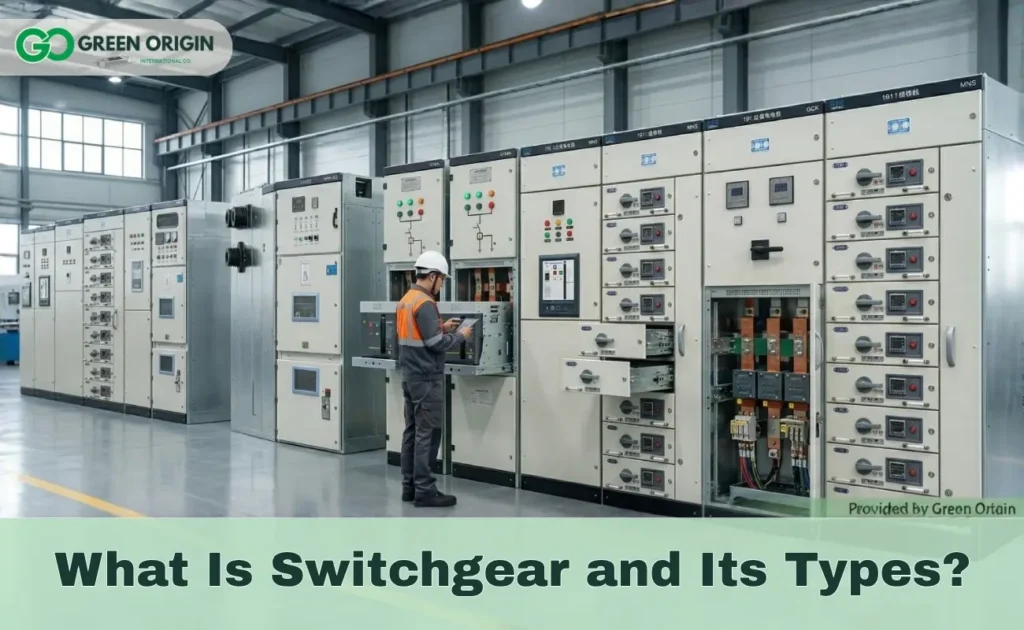
What is switchgear and its types is a critical starting point for any engineer or facility manager responsible for power system design, Switchgear encompasses the full range of electrical devices designed to safeguard, switch, and isolate circuits, from low-voltage distribution panels to high-voltage transmission substations, Selecting the right switchgear type determines the safety, reliability, and long-term performance of the entire electrical infrastructure across industrial, commercial, and utility applications.
What Is Switchgear and Its Types?
What is switchgear and its types is one of the most fundamental questions in electrical engineering,and the answer directly impacts how safely and efficiently any power system operates, From industrial plants to data centers and renewable energy farms, understanding switchgear meaning is the first step to building a reliable electrical infrastructure.
Modern power systems rely on switchgear to manage fault conditions, enable safe maintenance access, and ensure uninterrupted energy distribution across low, medium, and high-voltage networks, Each switchgear type is engineered for a specific voltage range and application, and selecting the right one determines the long-term safety, efficiency, and scalability of the entire electrical system, This guide covers the core switchgear types, their technical specifications, and the key factors that drive the right selection decision.
Read More: difference between switchgear and distribution board.
Exploring the Different Types of Electrical Switchgear:
The types of switchgear in what is switchgear and its types are primarily classified by voltage level, insulation medium, and construction type.
By Voltage Level:
| Type | Voltage Range | Typical Application |
| Low Voltage (LV) | Up to 1kV | Residential, commercial buildings, industrial distribution |
| Medium Voltage (MV) | 1kV to 36kV | Utilities, data centers, hospitals, industrial facilities |
| High Voltage (HV) | Above 36kV | Power transmission networks, large-scale industrial plants |
By Insulation Medium:
The insulation medium determines compactness, safety level, and environmental impact:
- Air Insulated (AIS): most common and cost-effective,uses ambient air,suitable where space is not a constraint.
- Gas Insulated (GIS): uses SF6 gas,extremely compact,preferred for urban substations and underground installations.
- Vacuum Insulated: high dielectric strength,low maintenance,widely used in medium to high voltage applications.
- Oil Insulated: uses mineral oil for insulation and cooling,carries fire and environmental risk.
Read More: Ring Main Unit Meaning: Electrical Distribution Guide.
The Basic Mechanism of Switchgear Work:
Understanding what is switchgear and its types requires knowing how it operates under fault conditions, When a fault is detected, the following sequence occurs:
- The protective relay senses the abnormal current immediately.
- The relay sends a trip signal to the circuit breaker.
- The circuit breaker interrupts current flow, isolating the faulty section.
- Healthy sections continue operating without interruption.
- Once the fault is resolved, the circuit is safely re-energized.
Overview of Core Switchgear Components:
Every what is switchgear and its types assembly consists of core components working together to ensure safe, reliable power distribution:
- Circuit Breakers: automatically interrupts fault currents to prevent equipment damage.
- Disconnect Switches: physically disconnect equipment from power supply for safe maintenance.
- Fuses: provide overcurrent protection for individual circuits.
- Busbars: distribute power from incoming supply to outgoing circuits.
- Protective Relays: detect fault conditions and trigger circuit breaker operation.
- Current & Voltage Transformers: step down high currents and voltages for metering and protection.
Essential Factors When Selecting Switchgear for Your Project:
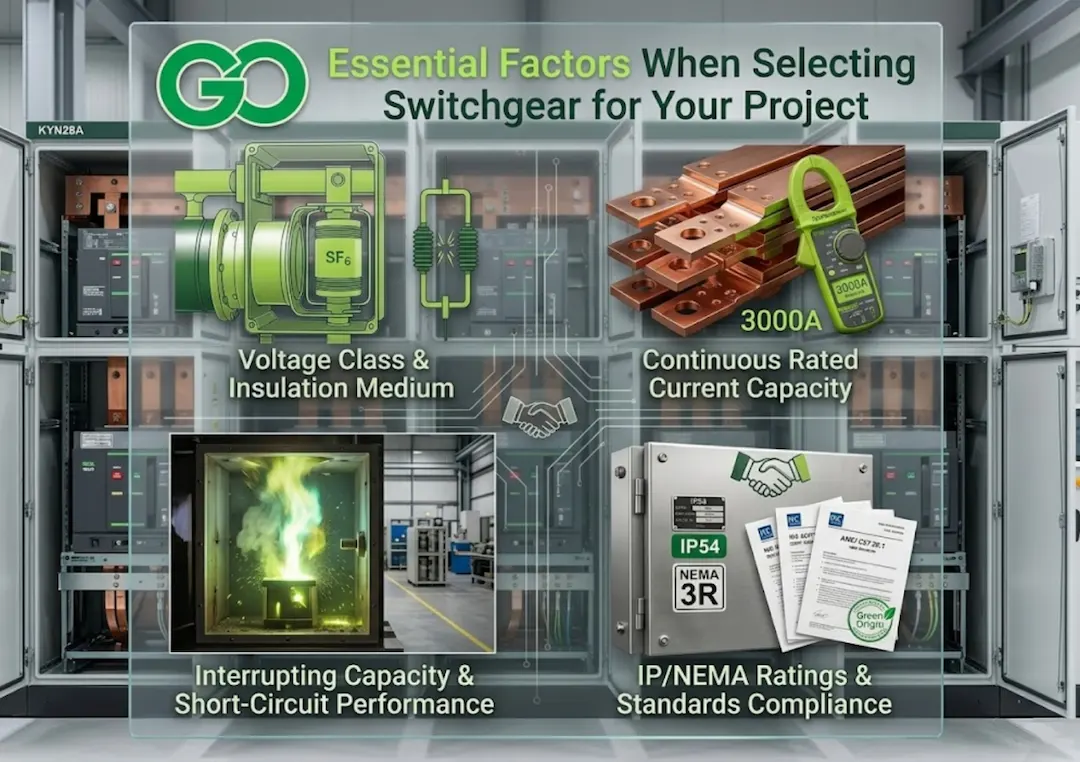
Selecting the right what is switchgear and its types solution requires careful evaluation of these critical parameters:
- Voltage level: match switchgear rating to system operating voltage.
- Current capacity: ensure maximum load current plus safety margin.
- Fault level: switchgear must safely interrupt maximum available fault current.
- IP / NEMA rating: select based on dust, moisture, and corrosion exposure.
- Compliance with standards: IEC 62271 for MV/HV,IEC 61439 for LV assemblies.
Installation Safety and Testing Considerations for Switchgear:
Proper installation and testing are non-negotiable requirements for any what is switchgear and its types project:
- Arc flash assessment, evaluate hazard levels before any live work.
- Insulation resistance testing, verifies integrity before energization.
- Circuit breaker timing tests, verify operations meet manufacturer specifications.
- Grounding and bonding verification, all metallic enclosures must be properly earthed.
- Functional testing, full operational test before commissioning.
Read More: High Voltage Cable Testing Methods: IEC Standards And Procedures.
Global Switchgear Market Statistics and Industry Trends:
The global what is switchgear and its types market reflects growing demand for reliable, intelligent power distribution. Key statistics for 2025:
- The global switchgear market was valued at USD 107.4 billion in 2024 and is projected to reach USD 188.7 billion by 2034, growing at a CAGR of 5.8%.
- Power transmission and distribution (T&D) utilities represent the dominant end-user segment, capturing 58.9% of the global switchgear market demand, driven by massive grid modernization and infrastructure projects.
- Low-voltage switchgear holds the largest segment share at 47.3% of global usage.
Key market drivers include smart grid investments, renewable energy integration, and the phase-out of SF6 gas in favor of eco-friendly alternatives.
Read More: Top Switchgear Companies in World.
Why Green Origin Is the Best Choice for Switchgear Solutions:
In a market demanding precision engineering, Green Origin delivers switchgear solutions built to meet rigorous international performance and safety standards.
- Verified compliance, products certified to GB3906, IEC298, IEC60439-1, GB7251.1, and DL404 depending on voltage class.
- Complete voltage range, from 380V/660V LV up to 40.5kV MV, covering every project requirement.
- Withdrawable architecture, draw-out designs minimize maintenance downtime across the full product range.
- Proven current capacity, handles up to 5000A continuous current for the most demanding industrial installations.
Top Switchgear Types and Electrical Solutions Provided by Green Origin:
Green Origin offers a precisely engineered product range covering the full spectrum of switchgear types for industrial and utility applications, from medium and high voltage down to low voltage motor control solutions.
Medium & High Voltage Switchgear:
- KYN28A 12: Armored Withdrawable AC Metal Enclosed Switchgear, 12kV, up to 3150A, IP4X – compliant with GB3906, GB/T11022, IEC298.
- KYN28A 24: Armored Withdrawable AC Metal Enclosed Switchgear, 24kV, up to 2500A, IP4X – compliant with GB3906, DL404, IEC298.
- KYN61 40.5: Armored Withdrawable AC Metal Enclosed Switchgear, 40.5kV, up to 2000A, IP4X.
Low Voltage Switchgear:
- MNS Low Voltage Switchgear: 380V/660V Withdrawable Cabinet, up to 5000A, IP54 – compliant with IEC60439-1, GB7251.1, JB/T9661.
- GCK Switchgear: 380V/660V Withdrawable MCC Cabinet, up to 4000A, IP40 – compliant with IEC60439-1, GB7251.1, NEMA ICS-2-322.
Trust Green Origin for premium switchgear solutions tailored to your industrial projects. Simply contact us or use WhatsApp to discuss your specifications and ensure a reliable power distribution system.
FAQs:
What is the main purpose of switchgear in a power system?
Switchgear controls, protects, and isolates electrical circuits during normal operation and fault conditions. When a fault occurs, it interrupts current to the affected section while keeping healthy circuits energized -preventing equipment damage and ensuring personnel safety.
What is the difference between Gas Insulated Switchgear (GIS) and Air Insulated Switchgear (AIS)?
GIS uses pressurized SF6 gas, making it extremely compact -requiring as little as 10% of the footprint of equivalent AIS. AIS uses ambient air, offering lower cost but requiring significantly more physical space.
What happens when electrical switchgear fails?
Switchgear failure causes unplanned outages, arc flash incidents, and equipment damage that can cascade through the entire system. Regular inspection and timely component replacement are the primary defenses against failure in any what is switchgear and its types installation.
