 Skip to content
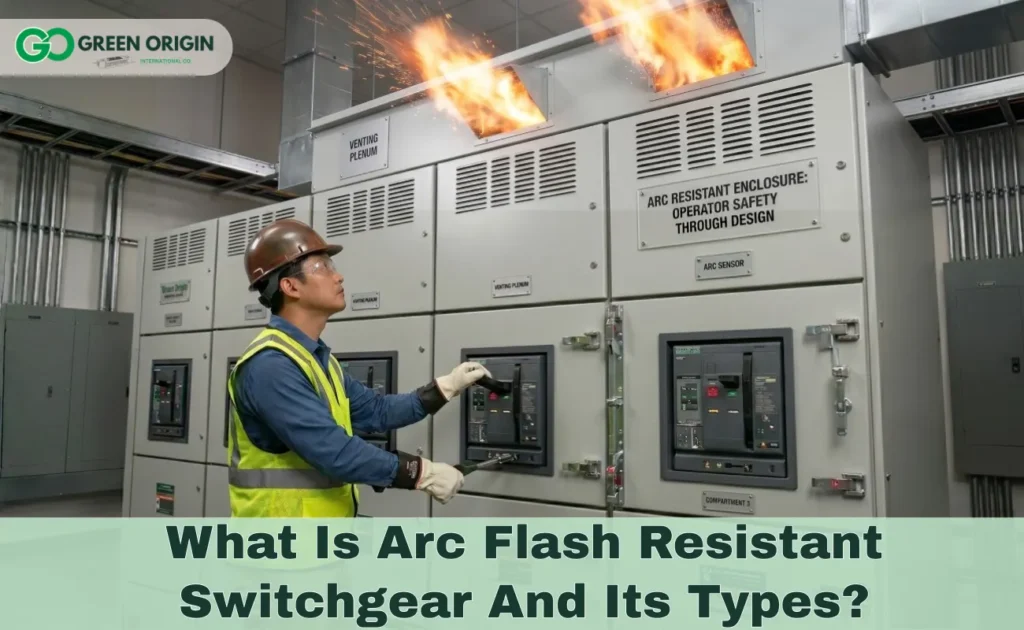
Arc flash resistant switchgear is purpose-built electrical equipment designed to contain and redirect arc flash energy away from personnel during an internal fault, According to industry estimates, approximately 30,000 arc flash incidents occur annually, resulting in 7,000 burn injuries, 2,000 hospitalizations, and 400 fatalities every year – making arc flash protection one of the most critical priorities in electrical system design.
What Is Arc Flash Resistant Switchgear?
Arc flash resistant switchgear is defined under ANSI/IEEE C37.20.7 as switchgear engineered to withstand internal arcing faults without allowing hazardous energy to escape toward operators, Unlike standard equipment, this arc flash rated switchgear is physically tested – not just calculated – before certification.
The key differences from standard switchgear are:
- Reinforced enclosures: Heavy-duty steel and sealed seams prevent arc energy from escaping
- Pressure relief venting: Plenum vents redirect hot gases away from operators
- Arc-resistant door latches: Spring-loaded catches withstand blast pressure without ejecting doors
- Physical type testing: Certified per ANSI/IEEE C37.20.7 or IEC 62271-200 – muslin cloth tests verify no burn-through at operator positions
Key Safety Statistics and Financial Impacts of Arc Flash Incidents
The scale of arc flash risk globally justifies investment in arc flash resistant switchgear. Key data points include:
- 30,000 arc flash incidents occur annually
- 7,000 burn injuries, 2,000 hospitalizations, and 400 fatalities per year in the US alone
- Arc flash temperatures reach up to 35,000°F – nearly four times hotter than the surface of the sun
- $10–15 million average litigation cost per general industry incident
- Arc blast pressure waves can exceed 2,000 lbs/sqft.
Read More: What Is Switchgear and Its Types for Industrial Projects?
Why Use Arc Flash Resistant Switchgear in Power Systems?
Specifying arc flash resistant switchgear delivers protection that standard equipment and PPE alone cannot provide, Unlike arc flash proof switchgear marketing claims, certified arc-resistant equipment has passed physical test protocols – not theoretical models:
- Personnel protection: Operators work with doors closed without entering the arc flash boundary.
- Reduced PPE requirements: NFPA 70E allows reduced PPE categories when doors are closed and secured.
- Placement flexibility: Equipment can be located in non-restricted areas where non-qualified personnel may pass.
- Reduced downtime: Arc-resistant enclosures contain damage to the faulted section, restoring power faster.
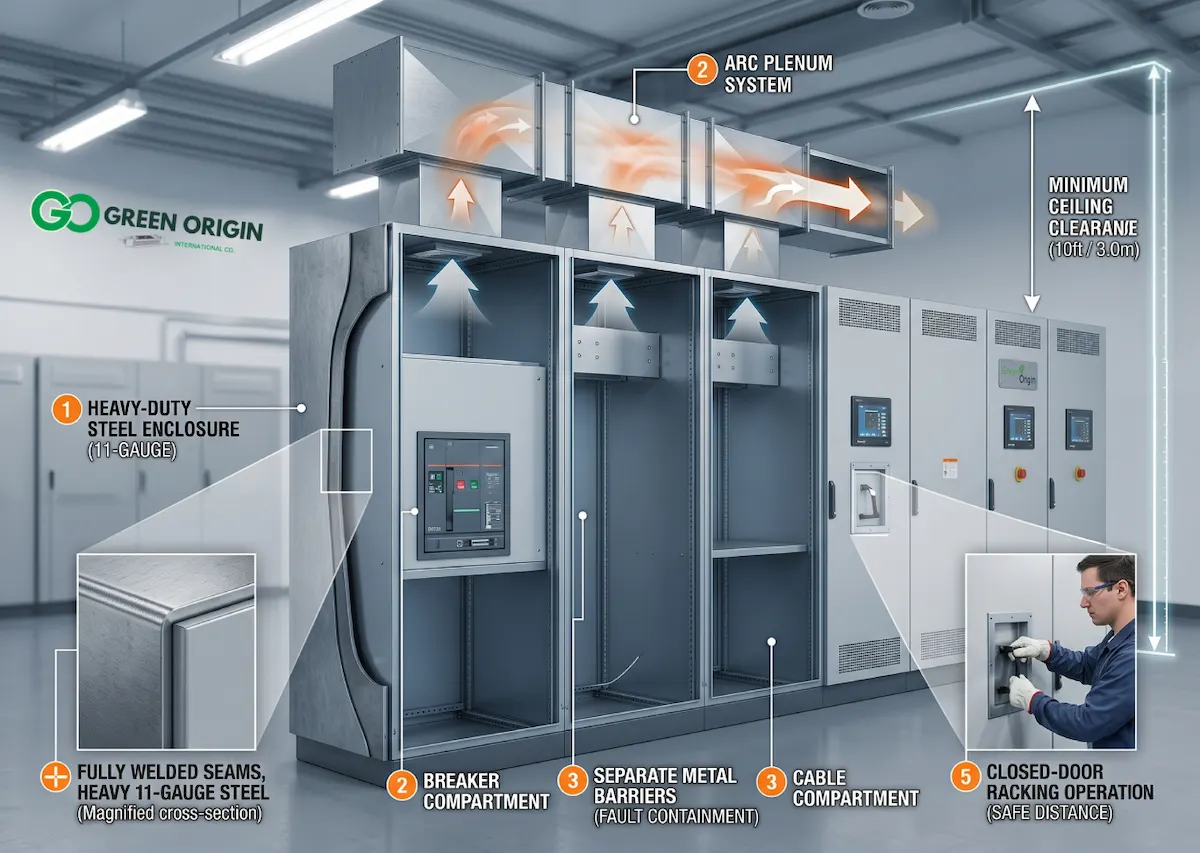
Arc Resistant Switchgear Design and Core Protection Features:
The design of arc flash resistant switchgear integrates multiple physical protection layers that work together to contain and redirect arc energy:
- Heavy-duty steel enclosures: Minimum 11-gauge steel panels with fully welded seams resist the mechanical shock of an arc blast.
- Arc plenum system: Duct above the switchgear lineup channels hot ionized gases to a safe exhaust point, away from operators and equipment.
- Compartmentalization: Separate metal barriers between breaker, bus, and cable compartments contain faults to the originating section.
- Minimum ceiling clearance: ANSI/IEEE C37.20.7 requires a minimum 3.05 meters (10 feet) floor-to-ceiling height for proper arc gas venting.
- Closed-door racking: Circuit breakers can be racked in and out with doors fully closed – eliminating exposure during the highest-risk operation.
Read More: Switchgear Components List and Specs for Projects.
Arc Resistant Switchgear Types and Accessibility Levels:
ANSI/IEEE C37.20.7 defines the arc-resistant switchgear types based on operator accessibility and protection scope:
| Type | Protection Scope | Description |
| Type 1 | Front only | Protection when operator stands in front with all doors closed – least restrictive placement requirement |
| Type 2 | All sides | Full perimeter protection – front, back, and sides – with all doors closed and secured |
| Type 2B | All sides + LV door open | Type 2 protection maintained when the low-voltage instrument compartment door is open |
| Type 2C | All sides + all doors open | Highest level – full arc resistance maintained even with all compartment doors open |
Arc Flash Switchgear Ratings and Safety Standards:
The arc resistant switchgear standards that govern design, testing, and certification of arc flash rated switchgear worldwide are:
- ANSI/IEEE C37.20.7: Primary US standard for testing metal-enclosed switchgear for internal arcing – defines Type 1, 2, 2B, and 2C classifications and the muslin cloth test protocol.
- IEC 62271-200 Annex AA: International standard for metal-enclosed MV switchgear above 1 kV – the IEEE C37.20.7 development process drew heavily from this annex.
- NFPA 70E (2024 Edition): Governs electrical safety work practices – permits reduced PPE requirements when arc-resistant switchgear is used with doors properly secured.
- IEEE 1584-2018: Arc flash incident energy calculation standard – used to determine required PPE category for specific equipment and fault current levels.
Active vs Passive Arc Flash Mitigation Strategies:
A complete arc flash protection strategy combines both active and passive measures. The full range of arc-resistant switchgear types represents the passive layer – while active systems provide additional protection:
Passive mitigation – built into the switchgear design, requires no external action:
- Arc-resistant enclosures: Certified Type 1, 2, 2B, or 2C construction containing and redirecting arc energy.
- Compartmentalization: Metal barriers limiting fault propagation between sections.
- Plenum venting: Directing hot gases safely away from operator positions.
Active mitigation – detects and clears arc faults before full energy release:
- Arc Flash Detection (AFD) relays: Light and current sensors detect arc initiation within 1–2 milliseconds.
- Zone-selective interlocking (ZSI): Accelerates breaker trip time, reducing energy release by up to 50%.
- Differential protection: High-speed relays clear internal bus faults faster than overcurrent protection alone.
How Green Origin Ensures Maximum Arc Flash Safety in Switchgear Systems?
Green Origin delivers arc flash resistant switchgear certified to ANSI/IEEE C37.20.7 and IEC 62271-200 – backed by physical type test documentation, not arc flash proof switchgear marketing claims:
- Certified Type 2B construction: Full perimeter protection maintained even with the LV instrument compartment door open.
- Integrated AFD relay option: Active arc flash detection reduces incident energy to near zero within milliseconds.
- Full type test documentation: Available for project approval and insurance compliance.
- Custom arc flash studies: Per IEEE 1584-2018 to optimize protection coordination for each installation.
Read More: Top Switchgear Companies in World.
Explore Green Origin Arc Flash Resistant Switchgear Products
Green Origin provides a full range of arc flash resistant switchgear across LV and MV applications:
- MV Arc-Resistant Metal-Clad Switchgear (5–36 kV): Type 2B certified; vacuum circuit breakers with closed-door motorized racking.
- LV Arc-Resistant Switchgear (up to 635V): Type 2B certified; tested to 85 kA for critical industrial, data center, and healthcare applications.
- Arc Flash Detection (AFD) Integration: Factory-fitted AFD relays for sub-millisecond fault detection.
- Custom Arc Flash Studies: IEEE 1584-2018 compliant incident energy analysis and PPE labeling.
For inquiries or OEM requests, contact Green Origin directly via Contact Us or WhatsApp, or visit the full product range on the Green Origin website.
FAQs:
What is an electrical arc flash?
A sudden release of electrical energy through ionized air between conductors, generating temperatures up to 35,000°F – causing severe burns, blast injuries, and equipment destruction.
What causes an arc flash in electrical switchgear?
Insulation failure, contamination, loose connections, improper circuit breaker racking, and human error during energized work on switchgear assemblies.
Is arc flash resistant switchgear mandatory?
Not universally – but arc resistant switchgear standards such as NFPA 70E increasingly require it where non-qualified personnel may be present or PPE clearance cannot be met.
Can standard switchgear be retrofitted to be arc resistant?
Limited retrofitting is possible via AFD relay installation, but full certification per ANSI/IEEE C37.20.7 requires enclosure replacement – not retrofit.
>What tests are required for switchgear to be considered “arc-resistant”?
Physical arcing tests per ANSI/IEEE C37.20.7 – muslin cloth indicators around all operator positions must show no burn-through at rated fault current and duration (typically 0.5 seconds).
