 Skip to content
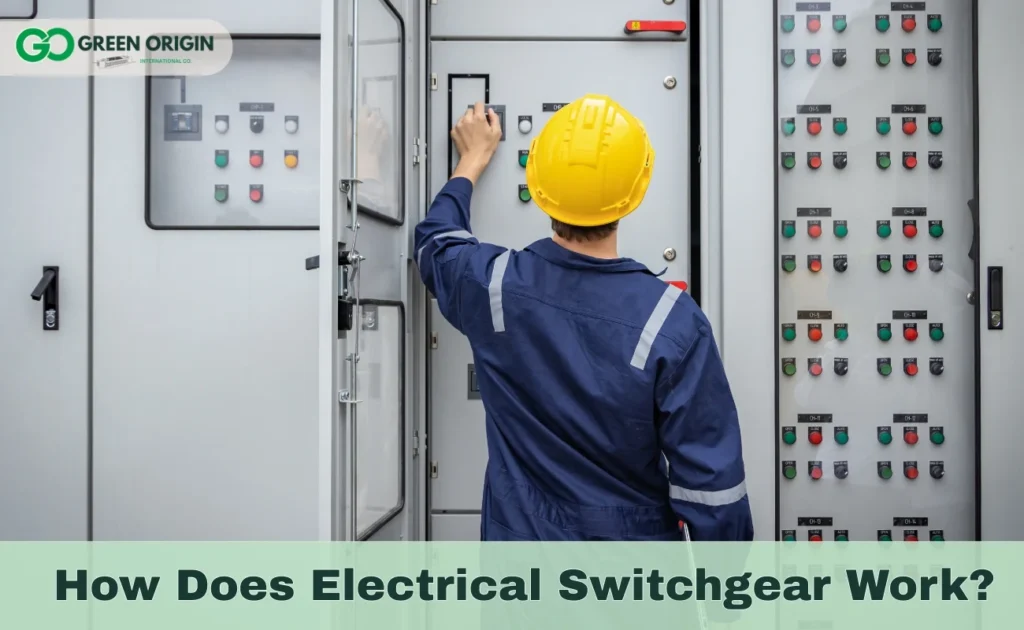
How does electrical switchgear work is one of the most searched questions among electrical engineers and facility managers worldwide, Switchgear is the backbone of any power distribution system – it protects, isolates, and controls electrical circuits under both normal and fault conditions, Understanding how does electrical switchgear work is essential for safe and efficient power management.
How Does Electrical Switchgear Work?
Knowing the answer to how does electrical switchgear work
Understanding how switchgear works starts with one principle: continuous monitoring of electrical parameters with instant response to any abnormal condition, The entire process – from fault detection to circuit isolation – happens in milliseconds, making it critical in any power network.
To fully understand how does a switchgear work, it helps to trace the complete sequence from sensing a fault to isolating it, Modern switchgear integrates three core functions:
- Protection: Detects faults and triggers isolation automatically.
- Switching: Opens or closes circuits under load or fault conditions.
- Control: Manages power flow across distribution networks.
According to the IEEE Standard C37.20.1, switchgear assemblies must meet strict interrupting capacity and dielectric withstand requirements to ensure safe operation across voltage levels.
Read More: difference between switchgear and distribution board.
Step by Step Working Principle of Electrical Switchgear:
Understanding how switchgear responds to a fault requires tracing the full sequence from detection to isolation, Each stage builds on the previous one in a precisely timed chain of events.
Fault Detection via Current and Voltage Transformers:
Current transformers (CTs) and voltage transformers (VTs) continuously sample line parameters, When values exceed preset thresholds, these transformers send a signal to the protective relay within microseconds.
- CTs measure line current and scale it down for relay input.
- VTs monitor voltage levels and detect dips, surges, or phase imbalances.
- Both feed real-time data to the protection relay simultaneously.
Signal Processing and Protective Relay Activation:
The protective relay analyzes incoming signals and determines whether a genuine fault exists, It filters transient disturbances from sustained faults before issuing a trip command.
Key relay functions in this stage include:
- Overcurrent protection (ANSI 51).
- Earth fault detection (ANSI 64).
- Differential protection for transformer-connected switchgear (ANSI 87).
The IEC 60947-2 standard defines performance requirements for protective devices within low-voltage switchgear, covering trip response times and breaking capacity thresholds.
Circuit Breaker Tripping and Fault Isolation:
Once the relay issues a trip signal, the circuit breaker opens the faulted circuit, This is the most mechanically intensive step – the breaker must interrupt current that may reach tens of kiloamperes.
The breaker isolation sequence works as follows:
- Trip coil receives relay signal.
- Mechanical latch releases breaker contacts.
- Contacts separate, initiating an electrical arc.
- Arc is quenched through the arc interruption mechanism.
- Circuit is fully isolated within 3–5 cycles (60–100ms at 50Hz).
Arc Quenching Mechanisms During Interruption:
Arc quenching is the defining performance factor of any switchgear unit, Without effective arc suppression, contact damage and re-ignition risk increase significantly.
Common arc quenching methods used in modern switchgear:
- SF₆ gas: Highly effective dielectric; used in high-voltage GIS switchgear.
- Vacuum interrupters: Standard in medium-voltage applications; no gas required.
- Air blast: Used in older outdoor high-voltage designs.
- Oil: Found in legacy distribution switchgear still in service globally.
Research published by CIGRE Working Group A3.28 confirms that vacuum and SF₆ technologies account for over 90% of new medium and high-voltage switchgear installations worldwide.
Read More: What Is Arc Flash Resistant Switchgear and Its Types?
What Are the Critical Uses of Switchgear in Modern Infrastructure?
Knowing the answer to how does electrical switchgear work makes it easier to understand why it appears across every sector that depends on reliable power, Its role extends well beyond simple switching – it actively safeguards equipment and personnel.
Critical applications include:
- Power generation plants: Generator protection and bus sectioning.
- Industrial facilities: Motor control centers and feeder protection.
- Data centers: Redundant switching for uninterrupted uptime.
- Utilities and substations: Network fault isolation and load management.
- Renewable energy: Inverter and transformer protection in solar and wind farms.
Read More: What Is Switchgear and Its Types for Industrial Projects?

How to Select Switchgear Based on Operational Requirements?
Selecting the right switchgear starts with matching technical specifications to the application’s demands, Several parameters determine the correct choice for any installation.
Key selection criteria include:
| Parameter | Consideration |
| Voltage rating | Must exceed system operating voltage |
| Breaking capacity | Must handle maximum prospective fault current |
| IP rating | Determined by installation environment |
| Standards compliance | IEC 61439 or ANSI/IEEE C37 series |
| Maintenance access | Fixed vs. withdrawable design |
Read More: Switchgear Components List and Specs for Projects.
Switchgear Operational Delay Statistics and Network Failure Risks:
Response time directly determines the extent of damage during a fault event. Faster isolation means less thermal and mechanical stress on connected equipment.
Industry data highlights the cost of slow or failed isolation:
- Uncleared faults lasting over 100ms can cause catastrophic busbar damage.
- According to the Electric Power Research Institute (EPRI), switchgear failures account for approximately 30% of unplanned outages in industrial power systems.
- Properly maintained switchgear reduces fault escalation risk by up to 60%.
Key International Standards Governing Switchgear Operational Performance:
Compliance with international standards ensures that the concept of — how does switchgear work — remains consistent and reliable across its full service life, Standards define testing requirements, ratings, and construction rules.
The most referenced standards globally:
- IEC 62271 series – High-voltage switchgear and controlgear.
- IEC 61439 series – Low-voltage switchgear and controlgear assemblies.
- ANSI/IEEE C37 series – Switchgear standards for North American markets.
- NEMA SG-5 – Power switchgear assemblies.
Read More: 9 Steps Switchgear Installation Procedure Pro Guide.
Trust Green Origin for Switchgear That Works Flawlessly Every Time:
Green Origin delivers switchgear engineered to perform under the most demanding grid and industrial conditions, Every unit is built to IEC standards, tested for full breaking capacity, and designed for long-term reliability with minimal maintenance requirements.
From medium-voltage GIS assemblies to low-voltage MNS panels, Green Origin’s switchgear portfolio covers every operational need – with technical support available at every stage of the project lifecycle.
Read More: Top Switchgear Companies in World.
Find Your Ideal Green Origin Switchgear Ready for Action:
Whether you’re specifying switchgear for a new substation, upgrading ageing infrastructure, or sourcing for an industrial expansion, Green Origin has the right solution. Understanding how does electrical switchgear work is the first step – choosing the right supplier is the next.
Contact the Green Origin technical team today to receive a tailored switchgear recommendation based on your system voltage, fault level, and installation environment.
Contact the Green Origin technical team today to receive a tailored switchgear recommendation based on your system voltage, fault level, and installation environment via our Contact Us page, WhatsApp, or Email.
FAQs:
How does a switchgear extinguish an electrical arc?
Switchgear uses vacuum interrupters, SF₆ gas, or air blast mechanisms to cool and extinguish the arc formed when contacts separate during fault interruption.
Can switchgear operate automatically without human intervention?
Yes, Modern switchgear integrates protective relays that detect faults and trigger circuit breaker tripping automatically, with no operator input required.
How fast does electrical switchgear operate during a fault?
Switchgear typically isolates a fault within 3 to 5 cycles – approximately 60 to 100 milliseconds at 50Hz – depending on relay settings and breaker type.
