 Skip to content
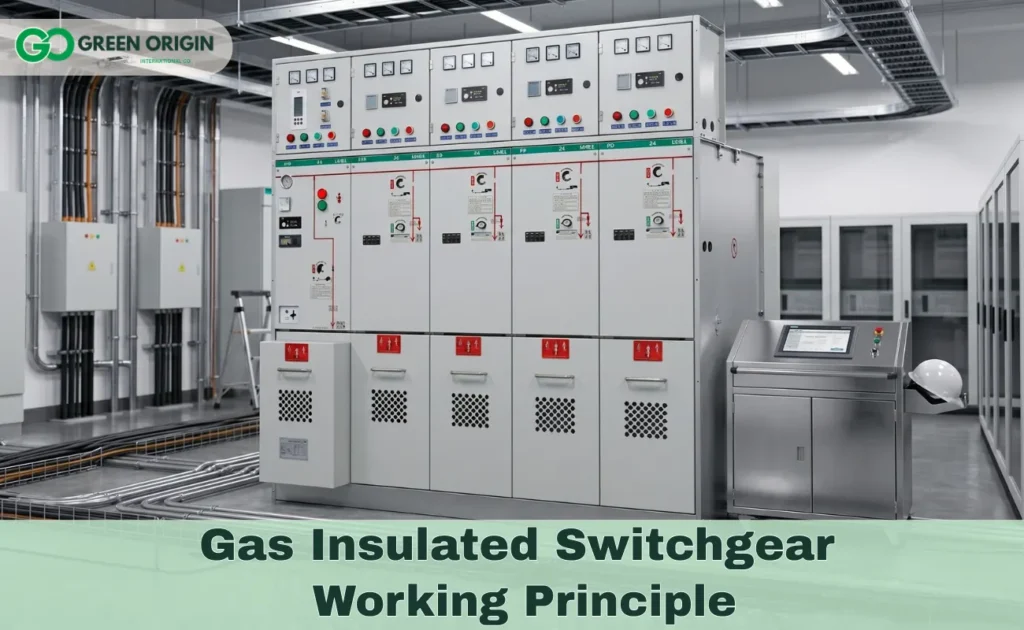
The gas insulated switchgear working principle is based on using sulfur hexafluoride (SF6) gas – or eco-efficient alternatives – as the primary insulating and arc-quenching medium inside sealed metal enclosures, The global GIS market was valued at USD 26.1 billion in 2024 and is projected to reach USD 55.8 billion by 2034, growing at 7.8% CAGR, driven by urbanization and grid modernization worldwide.
What Is Gas Insulated Switchgear?
Understanding the gas insulated switchgear working principle starts with the definition, GIS is a metal-enclosed gas insulated system where all high-voltage components are housed inside grounded aluminum or steel enclosures filled with dielectric gas – occupying only 10% of the space required by equivalent AIS installations.
GIS vs AIS – key differences:
| Feature | GIS | AIS |
| Insulation medium | Pressurized SF6 or eco-efficient gas | Atmospheric air |
| Space requirement | Up to 90% smaller footprint | Large open-air installation |
| Environmental sealing | Fully sealed – immune to dust, humidity, and pollution | Exposed to environment |
| Maintenance interval | Every 15–25 years | Every 3–5 years |
Read More: How Does Electrical Switchgear Work? A Complete Guide.
Gas Insulated Switchgear Working Principle:
The gas insulated switchgear working principle relies on two key properties of SF6 gas that no other medium at practical pressures can match:
- Dielectric insulation SF6 dielectric strength is 2.5–3× that of air at atmospheric pressure, At 4–6 bar inside GIS enclosures, live conductors sit millimeters from the grounded wall without breakdown.
- Arc quenching SF6 is significantly more effective than air at extinguishing arcs due to its superior thermal properties – capturing free electrons, de-ionizing the plasma, and extinguishing within milliseconds at natural current zero.
Operating sequence:
The complete fault cycle of the gas insulated switchgear working principle:
- Fault detected: Protection relay identifies overcurrent, earth fault, or differential fault.
- Trip signal issued: Relay sends trip command to circuit breaker mechanism.
- Contacts separate: Arc forms in SF6 atmosphere.
- Arc extinguished: SF6 de-ionizes at current zero – typically 1–3 cycles (20–60 ms).
- Isolation confirmed: Disconnector and earthing switch positions verified before maintenance.
Read More: Switchgear Components List and Specs for Projects.

Key Components of a Gas Insulated Switchgear System:
Every gas insulated switchgear working principle implementation depends on these core gas insulated switchgear components – all housed within the sealed gas-filled enclosure:
- Circuit breaker: SF6 puffer-type or self-blast – interrupts fault currents up to 63 kA; 12 kV to 800 kV.
- Disconnector: Visible isolation for maintenance – operates under no-load only; confirmed by position indicator.
- Earthing switch: Grounds isolated sections before maintenance – some designs rated for fault-making.
- Busbar: Aluminum conductor transmitting power between bays – single or double busbar configurations.
- Current transformer (CT): Toroidal design measuring primary current for protection and metering inside the enclosure.
- Voltage transformer (VT): Capacitive or inductive; factory-calibrated and sealed inside the GIS module.
- Cable termination / surge arrester: SF6-to-cable interface with stress cone and surge arrester protection.
Read More: What Is Arc Flash Resistant Switchgear and Its Types?
Advantages and Disadvantages of Gas Insulated Switchgear:
A balanced assessment of the gas insulated switchgear working principle requires evaluating both advantages and limitations:
| Advantages | Disadvantages |
| 70–90% space reduction vs AIS | Higher upfront CAPEX than AIS |
| High resistant to pollution, humidity, salt spray | SF6 is 23,500× more potent than CO₂ (GWP) |
| 15–25 year maintenance intervals | Requires specialized SF6 handling equipment |
| Fully enclosed – minimal arc flash hazard | Complex diagnostics for internal faults |
| Indoor/underground/offshore installation | Higher skilled labor requirement for servicing |
| High reliability – 99.99% availability | Full replacement required for severe internal faults |
Read More: What Is Switchgear and Its Types for Industrial Projects?
Where Is Gas Insulated Switchgear Used?
The gas insulated switchgear working principle makes GIS the preferred choice wherever space, environment, or reliability demands exceed AIS capabilities:
- Urban substations: Underground and indoor installations in city centers – eliminates the large open-air footprint in high-land-cost locations
- High-voltage transmission: 220 kV to 1,200 kV – according to Market Growth Reports, over 72% of new urban substations in densely populated countries used GIS in 2024
- Renewable energy: Offshore wind, solar, and HVDC stations – handles harsh marine environments where AIS cannot
- Railways and metro: Traction substations in tunnels where fire safety and compact design are mandatory
- Industrial plants: Chemical plants, refineries, data centers, and hospitals with high reliability and restricted space
Read More: Top Switchgear Companies in World.
How to Select the Right Gas Insulated Switchgear
Selecting GIS requires matching all gas insulated switchgear components to site-specific electrical and environmental parameters:
- Rated voltage: Must equal or exceed maximum system voltage – standard ratings: 12, 24, 36, 72.5, 145, 245, 420, 550, 800 kV per IEC 62271-203.
- Short-circuit breaking current: Must exceed available fault current – standard ratings: 25, 31.5, 40, 50, 63 kA
- Busbar configuration: Single busbar for distribution; double busbar for transmission
- Insulation technology: Conventional SF6 or SF6-free – select eco-efficient technology where EU Regulation 2024/573 applies
- Seismic rating: IEC 62271-207 seismic qualification required for installations above 0.3 g peak ground acceleration
Common Reasons for Failure in Gas Insulated Switchgear Systems:
Understanding failure modes is essential for GIS lifecycle management:
- Particle contamination: Metallic particles concentrate the electric field – the leading cause of internal dielectric breakdown; mitigated by particle traps and factory cleanliness protocols
- Gas leakage: SF6 leakage below minimum density reduces dielectric strength – pressure monitoring is mandatory per IEC 62271-203
- Moisture ingress: Water vapor corrodes contacts and degrades SF6 quality – dew point monitoring detects early ingress
- Circuit breaker mechanism failure: According to research published in ScienceDirect, mechanical failures account for approximately 25% of high-voltage circuit breaker failures
- Tap changer contact erosion: Repeated switching increases resistance and generates additional heat in GIS-integrated transformers
Read More: 9 Steps Switchgear Installation Procedure Pro Guide.
Green Origin Delivers Next Generation Gas Insulated Switchgear Technology:
Green Origin manufactures the complete range of gas insulated switchgear working principle solutions – from 12 kV distribution GIS to 252 kV transmission assemblies – certified to IEC 62271-203 and IEEE C37.122.
Every Green Origin GIS unit delivers:
- IEC 62271-203 certified: Full type-test documentation for utility tender submissions
- SF6 and SF6-free options: Conventional SF6 and eco-efficient clean air or fluoronitrile gas – compliant with EU Regulation 2024/573
- Smart monitoring: SF6 density monitors, partial discharge sensors, and IEC 61850 communication as standard
- Factory Acceptance Testing (FAT): All protection, control, and interlock functions tested before dispatch
- Full OEM/ODM capability: Custom voltage ratings, busbar configurations, and seismic ratings available
Upgrade Your Substation with Green Origin’s Premium GIS Units:
For project teams asking how does gas insulated switchgear work and integrate with existing infrastructure – Green Origin engineers provide full system studies and site-specific adaptation:
- MV GIS (12–40.5 kV): Compact indoor and outdoor units for distribution, industrial, and renewable energy applications.
- HV GIS (72.5–252 kV): Modular transmission GIS for new substations and AIS-to-GIS retrofits – reducing footprint by up to 80%.
- Hybrid GIS: Combines GIS and AIS in a single assembly – optimal for space-constrained retrofit projects.
- GIS substation design service: Single-line diagram review, protection coordination, and installation supervision.
Read More: Ring Main Unit Meaning: Electrical Distribution Guide.
For optimizing your power systems with cutting-edge GIS technology, OEM requests, or project details, contact Green Origin via our Contact Us page, reach out on WhatsApp, or email info@greenorigin-elec.com.
FAQs:
Why is GIS more compact?
SF6 gas has 2.5–3× the dielectric strength of air – allowing live components to be placed much closer together inside sealed metal enclosures, reducing overall substation footprint by up to 90% versus equivalent AIS.
Is SF₆ being replaced?
Yes – EU Regulation 2024/573 mandates phasing out SF6 in medium-voltage switchgear from January 2026, Per IEC 62271-203:2022, SF6-free alternatives using clean air, nitrogen, and fluoronitrile gas are now certified and commercially available for GIS applications up to 420 kV.
Is GIS safer than AIS?
Yes – all live parts are sealed inside earthed metal enclosures, eliminating exposure to operators, GIS reduces arc flash hazard to near zero during normal operation and provides Type 2 arc-resistant protection as standard.
