 Skip to content
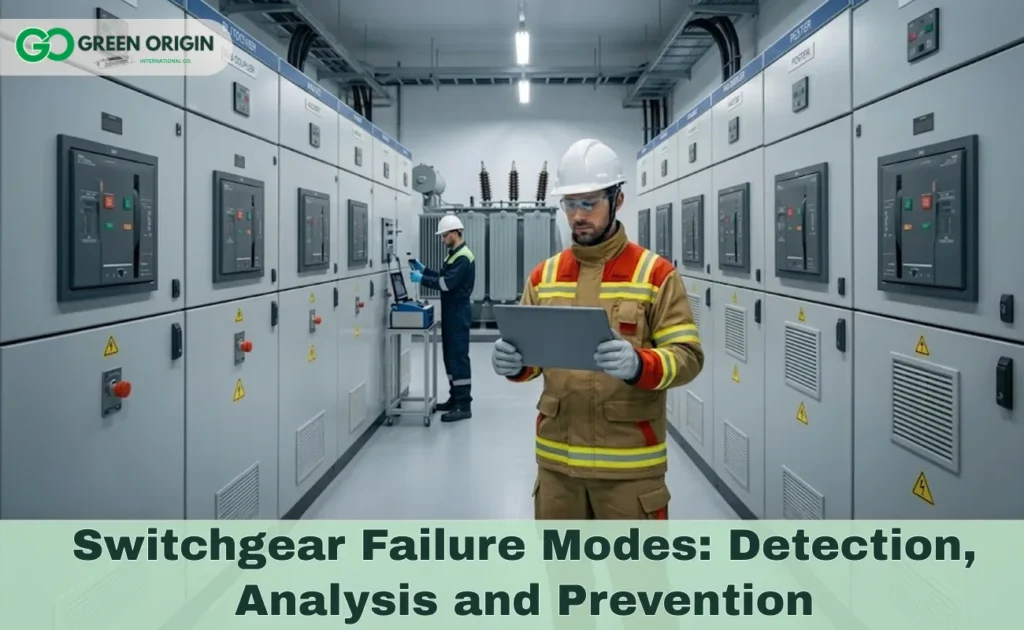
Switchgear failure modes are the leading cause of unplanned outages in industrial and utility power systems – and understanding them is the first step toward preventing catastrophic damage. From insulation breakdown to mechanical wear, each failure type follows a predictable progression that can be detected, analyzed, and mitigated before it escalates into a full system failure.
What Are Switchgear Failure Modes?
Switchgear failure modes are the defined categories of malfunction that cause switchgear to lose its ability to control, protect, or isolate electrical circuits – each with distinct causes, progression patterns, and detection methods.
The primary switchgear failure causes include:
- Insulation degradation: gradual breakdown of dielectric materials due to heat, moisture, and electrical stress – the most frequent root cause across all voltage classes.
- Overheating: driven by loose connections, overloading, or inadequate cooling – generates hotspots that accelerate insulation deterioration and contact erosion.
- Partial discharge: high-frequency electrical discharges within insulation voids – produces progressive damage that precedes full dielectric breakdown.
- Mechanical wear: contact erosion, spring fatigue, and operating mechanism degradation after repeated switching cycles.
- Environmental contamination: dust, metallic particles, and moisture – are a leading contributor to insulation failures in switchgear.
- Corrosion: oxidation of contacts and bus connections increases resistance, generates heat, and accelerates failure under load.
Read More: Switchgear Components List and Specs for Projects.
Why Do You Need to Understand Failure Modes?
Understanding switchgear failure modes is not an optional engineering exercise – it is an operational and regulatory requirement for any facility where unplanned outages carry safety or financial consequences.
The business case for failure mode awareness includes:
- Outage prevention: most switchgear failures produce detectable warning signs weeks or months before catastrophic damage occurs – early identification allows planned intervention.
- Regulatory compliance: NFPA 70E requires documented maintenance programs addressing known failure modes for all energized electrical equipment.
- Insurance validity: undocumented maintenance histories and unaddressed failure conditions are the leading grounds for denied claims following electrical incidents.
- Asset life extension: switchgear designed for 25 to 30 year service life can fail prematurely within 10 to 15 years when failure modes are not actively managed.
To effectively manage and mitigate these failure modes, engineers must first have a deep understanding of the internal parts that are vulnerable to electrical and mechanical stress.
Read More: What Is Arc Flash Resistant Switchgear and Its Types?
The Primary Families of Switchgear Failure Modes:
Electrical switchgear failure modes fall into three primary families – each requiring a different diagnostic approach and mitigation strategy.
Dielectric Failures:
Dielectric failures involve the breakdown of insulating materials – including solid insulation, SF6 gas, and air gaps – under electrical, thermal, or environmental stress, and represent the highest-consequence failure category due to their potential to cause arc flash events and complete equipment loss.
Thermal Failures:
Thermal failures originate from abnormal heat generation at connection points, contacts, or current-carrying conductors – progressive in nature and detectable through infrared thermography before they reach destructive temperatures.
Mechanical Failures:
Mechanical failures affect the operating mechanisms, contacts, and structural elements of circuit breakers, disconnectors, and earthing switches – typically manifesting as slow or failed operation, contact misalignment, or spring mechanism degradation after high switching cycle counts.
How to Detect Failure Modes Before Catastrophe
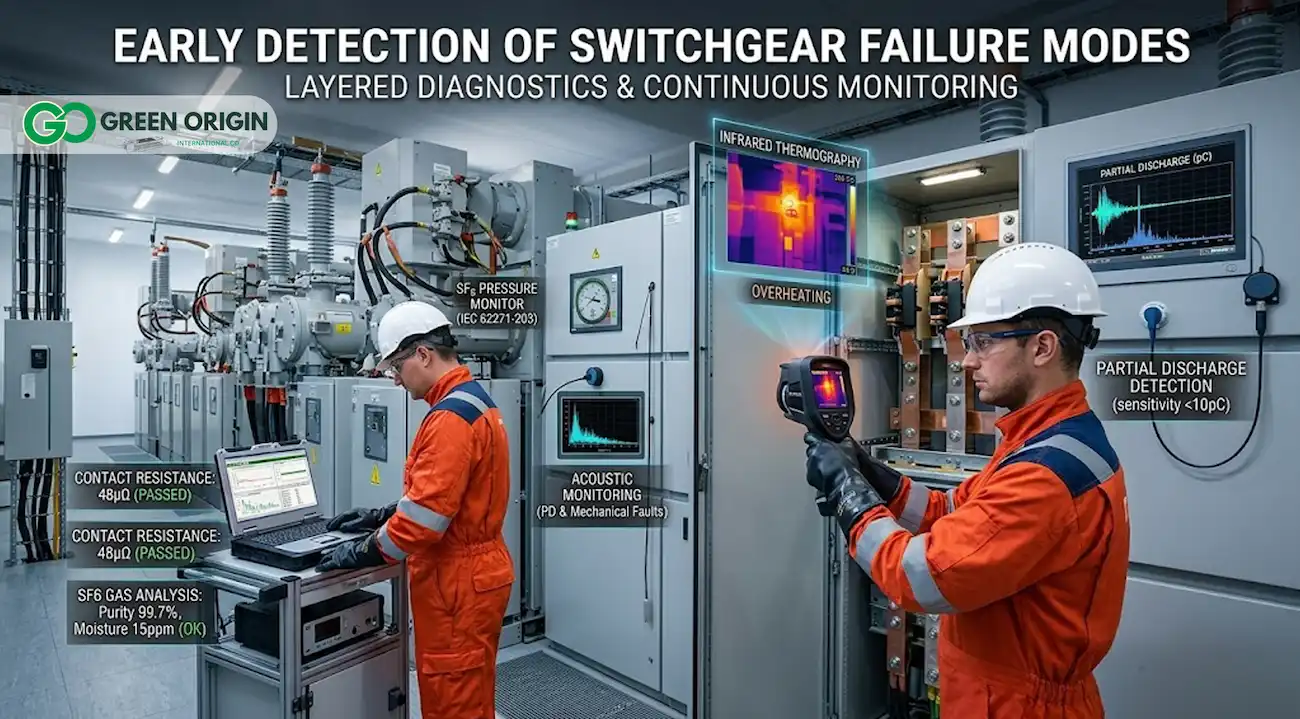
Early detection of switchgear failure modes requires a layered diagnostic program – combining periodic testing with continuous monitoring to cover all three failure families.
The core detection methods are:
- Infrared thermography: detects thermal anomalies at connections, contacts, and bus bars – identifies overheating before insulation damage begins, per IEC 62271-200.
- Partial discharge measurement: locates dielectric defects within insulation systems – detects developing faults years before failure, with sensitivity down to picocoulomb levels.
- Contact resistance testing: measures resistance across circuit breaker contacts – elevated values indicate contact erosion or contamination requiring intervention.
- SF6 gas analysis: monitors gas pressure, moisture content, and decomposition by-products in GIS equipment – mandatory under IEC 62271-203.
- Vibration and acoustic monitoring: detects partial discharge and mechanical anomalies through ultrasonic and acoustic emission sensors.
- Visual inspection: identifies corrosion, contamination, physical damage, and connection looseness – the foundation of any maintenance program under NFPA 70B.
How to Perform Root Cause Analysis (RCA) on Switchgear Failures?
Root cause analysis on switchgear failures requires a structured methodology – Failure Mode and Effects Analysis provides the framework most widely used in electrical asset management for identifying and prioritizing switchgear failure modes before they reach catastrophic stage.
What is Failure Mode and Effects Analysis (FMEA)?
Failure Mode and Effects Analysis is a systematic process that identifies every potential failure mode in a switchgear system, determines its effect on system function, and assigns a Risk Priority Number based on severity, occurrence probability, and detectability – allowing maintenance teams to prioritize interventions by risk level.
FMEA Risk Assessment Process:
FMEA risk assessment for switchgear follows four steps:
- List all components and their functions: circuit breakers, disconnectors, bus bars, CTs, VTs, and protection relays.
- Identify failure modes for each component: contact erosion, insulation breakdown, mechanism failure, gas leakage.
- Assess effects and assign RPN: severity x occurrence x detectability – RPN above 100 typically triggers immediate action.
- Define corrective actions: maintenance interval adjustments, component replacement schedules, or monitoring upgrades.
Post-Failure Investigation:
After a confirmed failure, RCA investigation collects maintenance records, thermal history, test data, and physical evidence – establishing whether the root cause was design, installation, maintenance, or operational in origin.
Read More: 9 Steps Switchgear Installation Procedure Pro Guide.
Proven Mitigation Strategies for Each Switchgear Failure Mode:
Each switchgear failure mode demands a targeted mitigation strategy – generic schedules alone are insufficient for high-reliability installations.
- Insulation degradation: partial discharge surveys every 2–3 years, dry enclosure environments, replace aging components at recommended intervals.
- Overheating: annual infrared thermography, torque connections to spec at each cycle, verify cooling performance.
- Mechanical wear: track breaker operation counts, test operating times, replace contacts when erosion exceeds 50%.
- Environmental contamination: maintain IP ratings, inspect seals at every maintenance, use desiccant breathers.
- Corrosion: anti-oxidant compound on bus connections, inspect contact plating, replace corroded hardware.
Read More: Top Switchgear Companies in World.
Why Green Origin Leads in Switchgear Reliability and Global Standards?
Green Origin designs switchgear with switchgear failure modes prevention built into the product architecture – every unit certified to IEC 62271-200 and IEC 62271-203 covering dielectric, thermal, and mechanical requirements.
- Factory partial discharge testing – verifying insulation integrity before dispatch.
- Silver-plated contact assemblies – reducing resistance degradation and corrosion-driven failure.
- IP54 minimum enclosure rating – protection against dust and moisture contamination.
- Full type-test documentation – supporting FMEA risk assessment and insurance compliance.
Green Origin’s Products That Directly Prevent All Switchgear Failure Modes:
Green Origin’s product range addresses every primary switchgear failure mode category – from distribution to transmission level.
- KYN28A 12: 12 kV, IP4X, draw-out design isolates contacts for inspection without de-energizing adjacent bays – in full compliance with arc flash and personnel safety standards .
- KYN28A 24: 24 kV, enhanced insulation class for reduced dielectric failure risk.
- KYN61 40.5: 40.5 kV, engineered for environments where partial discharge monitoring is critical.
- MNS Low Voltage Switchgear: 380V/660V, IP54, thermal isolation of individual feeders limiting overheating propagation.
FAQs:
What are the most common causes of switchgear failure?
The most common switchgear failure modes are insulation degradation, overheating, partial discharge, mechanical wear, and environmental contamination – all progressing from detectable indicators to catastrophic failure if unaddressed.
How to perform switchgear maintenance to prevent failure?
Effective maintenance combines infrared thermography, partial discharge testing, contact resistance measurement, visual inspection, and interval-based servicing adjusted by FMEA risk assessment findings.
What are the signs of insulation failure in switchgear?
Early signs include partial discharge activity, elevated leakage current, tracking marks on insulation surfaces, abnormal odor from thermal degradation, and reduced insulation resistance values during scheduled testing.
