 Skip to content
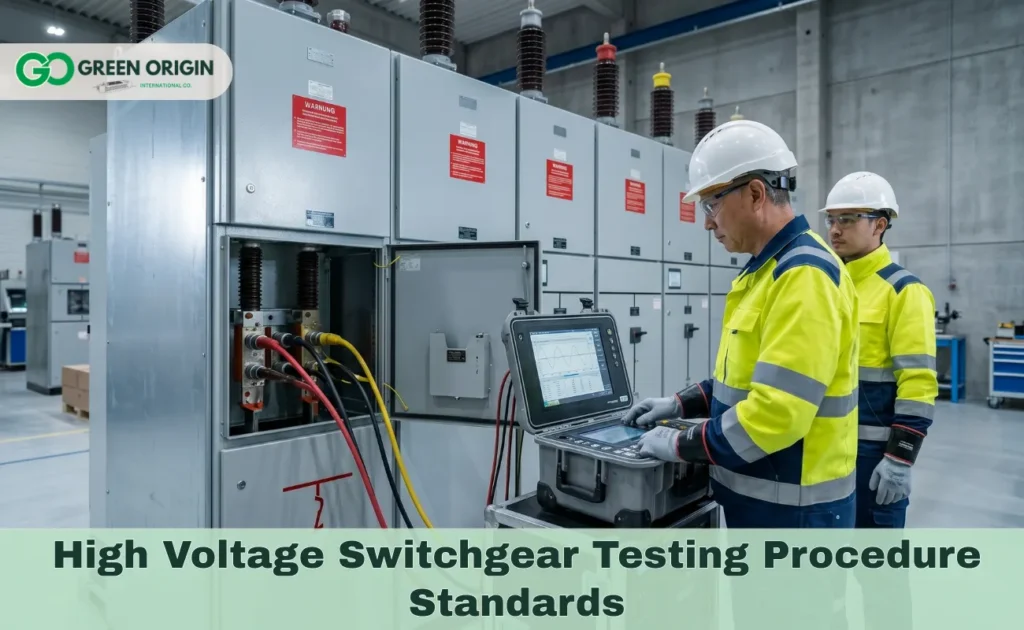
The high voltage switchgear testing procedure is the most critical quality gate in any power distribution project, and skipping or inadequately executing any stage of this process directly increases the risk of catastrophic equipment failure, personnel injury, and unplanned outages that cost industrial and utility operators millions of dollars per incident, which is why every engineer and project manager involved in switchgear procurement and commissioning must understand what each test stage verifies, why it matters, and what the consequences of failure are.
What Is High Voltage Switchgear Testing?
High voltage switchgear testing is a structured series of electrical, mechanical, and insulation verification activities confirming every component performs within rated parameters, governed by IEEE C37.09 and IEC 62271-200 which define minimum test procedures, acceptance criteria, and documentation requirements for all classes of high voltage switchgear worldwide.
Types of Switchgear Testing:
Electrical switchgear testing falls into three primary categories across factory and site environments.
- Type Tests – Performed once by the manufacturer to verify design meets all rated parameters.
- Routine Tests – Conducted on every unit before delivery to detect assembly defects before shipment.
- Commissioning Tests – Executed on-site after installation to verify the complete system is ready for energization.
Read More: Switchgear Failure Modes: Detection, Analysis and Prevention.
Why Is High Voltage Switchgear Testing Procedure Critical?
A rigorous high voltage switchgear testing procedure is non-negotiable for three interconnected reasons: personnel safety, asset protection, and regulatory compliance, and the consequences of inadequate testing are well-documented across the global power industry.
Safety and Reliability Consequences of Inadequate Testing:
Undetected insulation defects, incorrect protection relay settings, or loose connections that pass visual inspection but fail under load can trigger arc flash events, equipment explosions, and extended grid outages, and NFPA 70E 2024 explicitly identifies commissioning testing as a primary engineering risk reduction strategy that must be completed before any switchgear is energized for the first time.
Regulatory and Insurance Requirements:
Non-compliance with testing standards carries severe consequences across all market segments – grid codes require documented FAT and SAT evidence before connection agreements are issued, insurance underwriters require test certificates as a coverage condition, and non-compliance with IEEE or IEC standards can void warranties and create legal liability.
Financial Impact of Early vs Late Test Failures:
Defect timing directly determines remediation cost – factory rework takes days while post-installation rework requires weeks of outage coordination, and industry data shows unplanned substation outages in large industrial facilities exceed $250,000 per hour of downtime.
Read More: High Voltage Cable Testing Methods: IEC Standards & Procedures.
Critical HV Switchgear Dielectric and Partial Discharge Tests:
Dielectric and partial discharge testing form the technical core of any high voltage switchgear testing procedure, and both tests reveal different but complementary failure modes that no other inspection method can detect with equivalent reliability.
Dielectric Withstand Test:
The dielectric withstand test applies a voltage determined by the equipment’s rated voltage, standard level, and insulation coordination requirements across all insulation systems for a defined duration, confirming the insulation can handle transient overvoltages, switching surges, and lightning impulses .
- Applied voltage levels – Defined by IEEE C37.09 based on rated maximum voltage class and insulation coordination requirements.
- Test coverage – Applied phase-to-phase and phase-to-ground across open contacts, closed contacts, and all insulated barriers.
- Failure criteria – Any flashover, puncture, or sustained leakage current above the acceptance threshold requires investigation before the unit proceeds.
Partial Discharge Test:
Detects localized electrical discharges indicating progressive insulation degradation before complete breakdown occurs, using UHF or acoustic emission sensors.
- Measurement – Discharge levels measured in picocoulombs against IEC 62271-200 manufacturer and standard acceptance thresholds.
- New assembly activity – Elevated readings indicate manufacturing defects, contamination, or improper assembly requiring resolution before delivery.
Read More: 9 Steps Switchgear Installation Procedure Pro Guide.
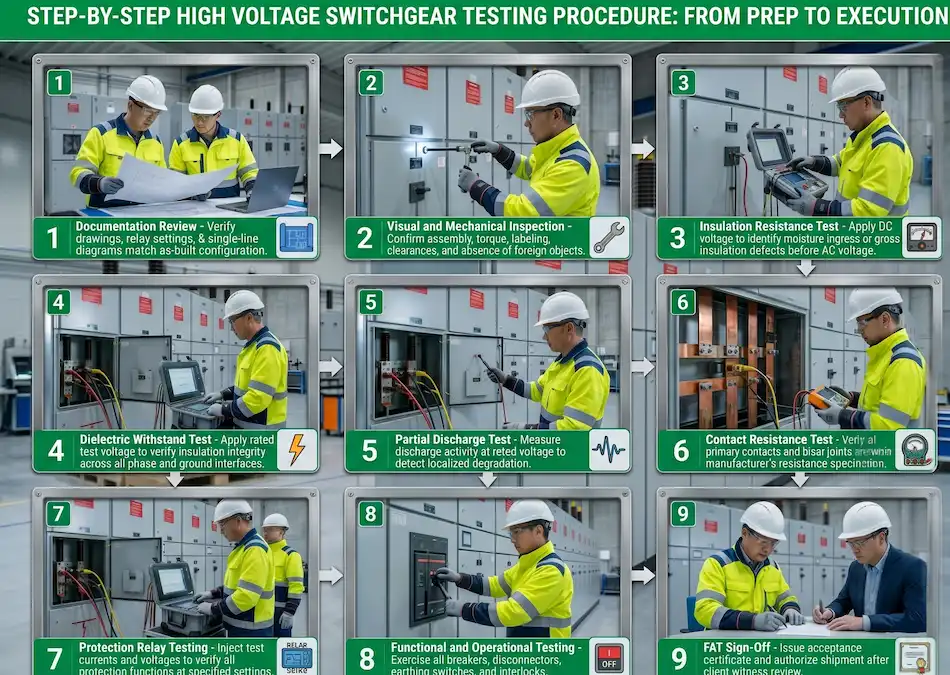
Step by Step High Voltage Switchgear Testing Procedure from Prep to Execution:
A complete switchgear testing and commissioning procedure follows a fixed sequence where each stage builds on the verified results of the previous one.
- Documentation Review – Verify drawings, relay settings, and single-line diagrams match as-built configuration.
- Visual and Mechanical Inspection – Confirm assembly, torque, labeling, clearances, and absence of foreign objects.
- Insulation Resistance Test – Apply DC voltage to identify moisture ingress or gross insulation defects before AC voltage.
- Dielectric Withstand Test – Apply rated test voltage to verify insulation integrity across all phase and ground interfaces.
- Partial Discharge Test – Measure discharge activity at rated voltage to detect localized degradation.
- Contact Resistance Test – Verify all primary contacts and bus bar joints are within manufacturer’s resistance specification.
- Protection Relay Testing – Inject test currents and voltages to verify all protection functions at specified settings.
- Functional and Operational Testing – Exercise all breakers, disconnectors, earthing switches, and interlocks.
- FAT Sign-Off – Issue acceptance certificate and authorize shipment after client witness review.
Read More: Switchgear Maintenance Procedure: A Complete Guide.
Solving Test Failures Moisture Issues and Site vs Factory Testing:
Test failures during a high voltage switchgear testing procedure are not uncommon, and understanding the most frequent causes and their remediation paths is essential for keeping commissioning schedules on track and avoiding costly delays.
Most Common Test Failure Causes and Remediation:
The following failure modes account for the majority of test non-conformances, each with a defined remediation path.
- Moisture contamination – Leading cause of insulation resistance failures on site, resolved by controlled drying using space heaters or temporary climate control before retesting.
- Loose connections – Transport vibration loosens bus bar joints and terminations, resolved by retorquing all connections to manufacturer’s specified torque values.
- Incorrect relay settings – Factory parameters require adjustment after the final protection study is completed and verified against actual network parameters.
- Surface contamination – Dust, oil, or condensation on insulators causes elevated partial discharge and dielectric failures, resolved by cleaning with approved solvents before retesting.
Factory Acceptance Testing vs Site Acceptance Testing:
Understanding the distinction between FAT and SAT is fundamental to planning any types of switchgear testing program, and both stages serve distinct and non-interchangeable verification purposes that together provide complete confidence in system performance.
| Parameter | FAT | SAT |
| Location | Manufacturer’s factory | Installation site |
| Timing | Before shipment | After installation |
| Scope | Individual panel verification | Complete system integration |
| Cable terminations | Not included | Fully included |
| Protection coordination | Individual relay settings | Full system coordination check |
| Standards reference | IEEE C37.09 / IEC 62271-200 | IEEE C37.09 / project specs |
| Client witness | Optional but recommended | Required for grid connection |
Why Green Origin Leads in High Voltage Switchgear Testing Reliability?
As a leading Electrical Equipment Manufacturer, Green Origin applies a comprehensive high voltage switchgear testing procedure to every assembly, combining full IEEE and IEC compliance with in-house dielectric, partial discharge, and protection relay testing capabilities – contact Green Origin today to discuss your project requirements and receive expert support from specification through site commissioning.
Need expert assistance with your testing and commissioning requirements? Visit our Contact Us page, message our engineering team directly on WhatsApp, or email us at contact@greenorigin-elec.com to ensure your electrical assets are fully compliant, safe, and ready for energization.
FAQs:
How often should high voltage switchgear be tested?
IEEE and IEC standards recommend routine insulation and contact resistance testing at intervals defined by the manufacturer’s guidelines and site operating conditions, with full protection relay testing frequency determined by equipment criticality and environmental factors .
What’s the difference between FAT and SAT?
FAT verifies individual panel performance at the factory before shipment, while SAT verifies complete system integration and protection coordination on site after installation and cable termination.
What standards apply to high voltage switchgear testing?
The primary standards are IEEE C37.09 for test procedures, IEC 62271-200 for AC metal-enclosed switchgear, and NFPA 70E for electrical safety requirements during commissioning activities.
